









EDITORIAL | IGP Dan Bahadur Karki: A Leadership of Action, Institutional Reform and Public Trust

By Hark Bahadur Tamrakar (HB Tamrakar)
Editor-in-Chief | The Ton News
www.thetonnews.com
Building a Stronger Nepal Police Through Leadership, Integrity and Service

The Nepal Police is more than a law enforcement institution. It is one of the most important pillars of national security, justice, constitutional governance and public confidence.
The true strength of a police organization is not measured merely by its uniform, rank, weapons or authority. It is measured by its professionalism, integrity, accountability, operational effectiveness and, above all, the trust it earns from ordinary citizens.
In this context, the leadership of Inspector General of Police (IGP) Dan Bahadur Karki deserves attention for its emphasis on institutional reform, modernization, police welfare and citizen-oriented service.
A Professional Career Built Through Experience
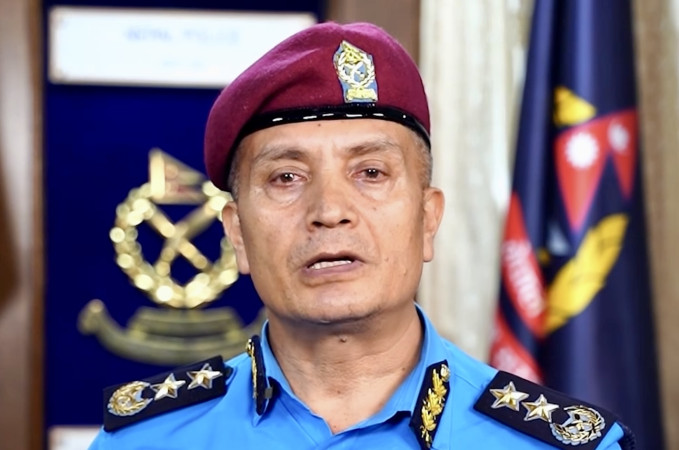
Dan Bahadur Karki is the 33rd Inspector General of Nepal Police. He joined the organization as a Police Inspector on March 31, 1998, and has served in numerous operational, investigative, administrative and strategic positions throughout his career.
His professional journey includes responsibilities in Kathmandu, Kaski, Butwal, Kapilvastu and other important police units. He has also served in the Commission for the Investigation of Abuse of Authority (CIAA), Narcotics Control Bureau, Special Bureau, Human Rights Violation Monitoring Unit and Interpol-related assignments.
His international exposure includes United Nations peacekeeping missions in East Timor and Haiti.
With more than 22 specialized national and international training courses, including crime investigation, operational command, human rights, emergency response and national security, Karki brings considerable institutional experience to the highest police leadership position.
He holds a Master’s degree in Political Science and bachelor’s degrees in Law, Education, and Humanities and Social Sciences. His professional recognition includes the Prabal Janasewa Shree and United Nations Service Medal.
These experiences provide an important foundation for leading a modern and increasingly complex security organization.
Modernization: Taking Nepal Police into the Digital Era
One of the significant areas of reform under Karki’s leadership has been the modernization of Nepal Police.
The establishment of an Artificial Intelligence and Advanced Analytics Cell at Police Headquarters represents an important step toward technology-driven policing.
Other initiatives include:
- Digital complaint registration through the Nepal Police Mobile App.
- Improved digital tracking and recording systems for accused persons and offenders.
- Expansion of CCTV surveillance in coordination with relevant authorities.
- Modernization of forensic and investigative capabilities.
- Initiatives toward drone and anti-drone operational capabilities.
- Development of institutional performance evaluation and accountability systems.
The introduction of a three-year Nepal Police Strategic Plan for 2083–2085 further reflects the intention to strengthen public service through technology, organizational reform and professional development.
The objective should be clear: faster services, stronger investigations and greater public confidence.
Strengthening Police Welfare and Personnel Motivation
An institution cannot become stronger if its own employees are neglected.
Karki’s leadership has also emphasized police welfare, financial support and staff motivation.
According to Nepal Police’s published progress report, welfare facilities have been expanded, including emergency concessional loans at a five-percent interest rate, alongside educational, housing, vehicle and medical assistance schemes.
The organization has also provided various forms of concessional financial assistance to thousands of police personnel.
Such measures are important because motivated, professionally supported and financially secure police personnel are better positioned to serve citizens.
A strong police organization begins with the well-being of its own people.
Community Policing: Bringing Citizens Closer to the Police
The concept of community-oriented policing must become a practical reality throughout Nepal.
Under the Community-Police Partnership initiative, thousands of public awareness and community engagement programmes have been conducted, reaching a substantial number of citizens.
Special attention to women, children, senior citizens and vulnerable communities is equally important.
Karki has emphasized victim-friendly policing, human sensitivity and improved service delivery. The development of dedicated service centres for women, children and senior citizens is another positive institutional direction.
A citizen visiting a police station should receive respect, assistance and confidence—not fear or humiliation.
A Police Force That Must Remain Above Political Pressure
Perhaps the most important responsibility of any IGP is protecting the institutional independence and professional dignity of Nepal Police.
The police must serve the Constitution, not political interests. Law enforcement must remain impartial, regardless of political influence, personal relationships, wealth or social status.
Journalists must be able to perform their professional duties without intimidation. Citizens must be able to express their opinions within the framework of the law. Every police action must follow due process, respect human rights and remain accountable.
The principle is straightforward: no individual or institution is above the Constitution.
A strong IGP is not one who exercises authority without limits, but one who ensures that authority is exercised responsibly and lawfully.
Honouring Sacrifice and Rebuilding Institutional Confidence
Nepal Police has experienced difficult periods, including the tragic security challenges of September 2025 and subsequent damage to police infrastructure.
At the 71st Police Day on October 16, 2026, IGP Karki paid tribute to police personnel who sacrificed their lives in service to the nation and highlighted the importance of rebuilding and modernizing the organization.
According to his Police Day address, 453 of the 459 damaged police stations had been rebuilt and were operational, with reconstruction continuing at the remaining locations.
This institutional recovery represents an important chapter in restoring operational capacity and public service.
The sacrifice of police personnel should never be forgotten, and their families deserve lasting respect and institutional support.
The Road Ahead: Results, Accountability and Public Confidence
The leadership of IGP Dan Bahadur Karki should ultimately be measured by tangible outcomes.
Effective crime investigation, reduction in organized crime, control of drug trafficking, cybercrime prevention, disaster response, traffic management, professional discipline and impartial service delivery must remain central priorities.
Technology should support human judgment, not replace it. Institutional discipline should strengthen accountability, not silence legitimate concerns. And organizational authority should always remain within constitutional boundaries.
The public does not expect perfection from any institution. It expects honesty, fairness, responsibility and visible improvement.
EDITORIAL CONCLUSION
Dan Bahadur Karki represents a leadership profile shaped by decades of policing experience, international exposure, institutional responsibilities and an emphasis on modernization.
His initiatives in digital policing, police welfare, strategic planning, community engagement and organizational capacity building provide meaningful areas for public evaluation.
Nepal needs a police organization that is confident, professional, politically impartial, technologically capable and genuinely connected to its citizens.
The IGP’s greatest legacy will not be determined by the number of orders issued or ceremonies attended. It will be determined by whether ordinary Nepalis feel safer, whether victims receive justice, whether police personnel work with dignity and whether the institution earns lasting public confidence.
The uniform represents authority, but public trust represents legitimacy.
A police force that earns the people’s trust is a police force that strengthens the nation.
Nepal Police must stand tall—not because of its power over citizens, but because of its commitment to protecting them.