








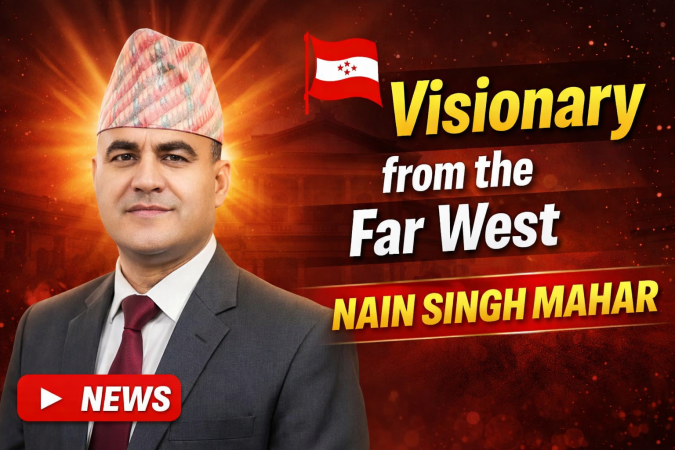


Visionary from the Far West: The Relentless Journey of Nain Singh Mahar

Dadeldhura, Nepal —
History occasionally produces leaders whose personal struggles mirror the broader political and social transformation of their nations. From the rugged hills of Nepal’s Far-Western district of Dadeldhura has emerged one such figure — Nain Singh Mahar — whose life journey from a village cattle herder to a national-level policymaker stands as a powerful symbol of resilience, vision, and democratic commitment.
Born on August 14, 1974 (B.S. 2031 Shrawan 14) in Bhageshwar Rural Municipality–3, Lamikande, to Tula Mahar and Lalita Mahar, Nain Singh Mahar grew up in a modest, middle-class family shaped by hardship, poverty, and systemic neglect. Witnessing social injustice, lack of education, and state discrimination from an early age, he developed a deep conviction that “without policy change, destiny cannot change.” This belief became the philosophical foundation of his political life.
From Student Leader to National Figure
Mahar formally entered politics during Nepal’s historic 1990 democratic movement. At just 16, he became President of the Nepal Students’ Union (NSU) unit at Asigram Secondary School. His defining moment came in 1990 when his powerful speech at a public event attended by senior Nepali Congress leaders, including Sher Bahadur Deuba, drew national attention and encouragement — marking a turning point in his political journey.
He steadily rose through the ranks of student politics, becoming Acting District President and later elected District President of NSU Dadeldhura. In 2016 (B.S. 2073), he was elected Central President of the Nepal Students’ Union, one of Nepal’s most influential student organizations.
A Reformer of Student Politics
As NSU President, Mahar is widely credited with initiating historic reforms. He championed age limits (32 years in student wings and 28 years in Free Student Union elections) to end the long-standing culture of “permanent students” dominating student politics. These reforms opened leadership opportunities for thousands of young and energetic students across the country.
He also played a key role in introducing policies allowing students to access loans by using academic certificates as collateral, expanding access to higher education and entrepreneurship for underprivileged youth. His leadership was instrumental in promoting the semester system at Tribhuvan University and supporting the establishment of Nepal Open University.
Paying the Price for Democracy
Mahar’s commitment to democracy has come at great personal cost. During the 2006 People’s Movement, he spent three months in prison. In 2008, on the eve of the Constituent Assembly elections, he was abducted and brutally assaulted by an armed group, left for dead on a riverbank. Miraculously surviving, he returned to public life the very next day, continuing his campaign despite severe injuries — an act that cemented his reputation as a fearless and committed leader in Dadeldhura.
Scholar-Politician with a Global Outlook
Unlike many in Nepal’s political landscape, Mahar is known for his strong academic background. He holds a Master’s degree in Political Science, a Bachelor’s degree in Law (LLB), and an MPhil (First Division). He is currently pursuing a PhD in Political Economy.
He is also the author of several influential books, including Challenges of Education, Mahakanda, Now the Congress, and Sankalpa, which focus on education reform, party democracy, and contemporary political challenges.
Mahar founded the School of Democracy, an international civic education platform now active in more than 33 countries, training thousands of young people in democratic leadership, governance, and civic responsibility.
Education, Health, and Youth Employment at the Core
Currently a Central Working Committee Member of the Nepali Congress and Head of its Education Department, Mahar is a strong advocate for making education and healthcare full state responsibilities. He argues that true national progress is impossible as long as quality education and healthcare remain privileges of the wealthy.
Combating youth migration is one of his top priorities. Through initiatives like the “Return to Dadeldhura Campaign,” Mahar seeks to channel the skills, capital, and technology of Nepalis abroad back into local development. He promotes policies such as “earn while you learn,” local entrepreneurship, and modernization of agriculture to strengthen rural economies.
A Development Vision for Dadeldhura
Mahar has outlined an ambitious development roadmap for Dadeldhura, focusing on religious tourism, eco-tourism, and education. Key sites such as Ugratara, Parshuram Dham, Ajaymerukot, and Amargadhi Fort are part of his plan to create a religious and cultural tourism circuit. He also envisions developing the Mahabharat Lekh region as a hill station and transforming Dadeldhura into a national education hub.
Bridge Between Generations
Often viewed as a potential political successor to Prime Minister Sher Bahadur Deuba, Mahar represents a rare blend of legacy leadership and modern political thinking. With strong digital engagement, international exposure, and a deep understanding of youth aspirations, he is widely seen as a bridge between Nepal’s older political generation and the emerging Gen Z leadership.
A Symbol of Hope
In sum, Nain Singh Mahar is not merely a politician — he is a symbol of struggle, ideas, and forward-looking leadership. His rise from rural hardship to national prominence reflects both personal determination and Nepal’s democratic evolution. For many in Dadeldhura and beyond, his leadership represents not just individual success, but the victory of vision, perseverance, and the promise of a more inclusive and prosperous Nepal.