









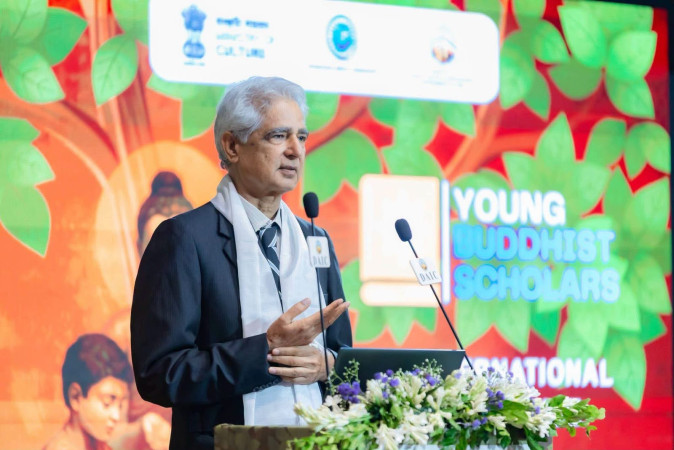

Prof. K. T. S. Sarao Appointed First SCO Chair Professor of Shared Buddhist Heritage at Nalanda University

RAJGIR, BIHAR: Nalanda University has appointed Prof. Karam Tej Singh (K. T. S.) Sarao, a distinguished scholar of Buddhist Studies and former Professor and Head of the Department of Buddhist Studies at the University of Delhi, as the first SCO Chair Professor of Shared Buddhist Heritage.
The prestigious academic appointment marks a significant step in Nalanda University’s efforts to promote intellectual, cultural and academic engagement across Asia. The SCO Chair on Shared Buddhist Heritage has been established in line with India’s engagement with the Shanghai Cooperation Organization (SCO), with the objective of advancing research, dialogue and academic collaboration on the shared Buddhist heritage of SCO member countries.

The Chair will provide a dedicated platform for advanced research into the historical, philosophical, cultural, linguistic and archaeological dimensions of Buddhism and its transmission across Asia. It is also envisaged as a forum for scholars, researchers and academic institutions to examine the civilizational connections created through the movement of Buddhist ideas, texts, teachers, pilgrims and artistic traditions across the region.
Prof. Sarao brings extensive academic experience to the position, with a distinguished career spanning Buddhist philosophy, Pāli literature, ancient Indian history, pilgrimage, sacred geography and Indian religious and intellectual traditions.
He is a former Professor and Head of the Department of Buddhist Studies at the University of Delhi. His academic career includes doctoral degrees from the University of Delhi in 1985 and the University of Cambridge in 1989, reflecting extensive academic training in both India and the international scholarly environment.
Prof. Sarao has authored and co-authored numerous works on Buddhism, Pāli, Indian religious traditions, ancient Indian history and pilgrimage. His notable publications include Baku’s Temple of Eternal Fire (Bloomsbury, 2021), The History of Mahabodhi Temple at Bodh Gaya (Springer, 2020), Encyclopedia of Buddhism and Jainism, co-authored with J. D. Long (Springer, 2017), The Decline of Buddhism in India: A Fresh Perspective (2012), Pilgrimage to Kailash: The Indian Route (2009), and The Dhammapada: A Translator’s Guide (2009).
His scholarship has received recognition in India and abroad. In 2018, the President of India conferred upon him a Certificate of Honour for his contribution to the field of Pāli Language. He also received an honorary doctorate from PSR Buddhist University in Phnom Penh in 2011 and another honorary doctorate from the Central University of Punjab, Bathinda, in 2025.
In 2019, Vietnam Buddhist University, Ho Chi Minh City, honored him with a Lifetime Award for Outstanding Academic Performance and Educational Excellence. The Ministry of Culture, Government of India, also conferred upon him the Vesak Citation of Honour in 2020.
His appointment carries particular significance at Nalanda University, an institution whose identity is closely associated with the history of Buddhist learning and the movement of knowledge across Asia.
Ancient Nalanda was one of the major centres of learning in the pre-modern world and attracted scholars and students from different parts of Asia. Through networks of monks, teachers, translators and pilgrims, its intellectual influence extended well beyond the Indian subcontinent.
The contemporary Nalanda University seeks to carry forward that legacy through an international academic environment focused on interdisciplinary education, advanced research and collaboration. Its academic programmes include Buddhist Studies, philosophy, comparative religions and other disciplines related to Asian civilizations and intellectual traditions.
The establishment of the SCO Chair adds a new dimension to this mission by creating an institutional platform to study historical connections between India and other parts of Asia through the shared heritage of Buddhism.
As the first holder of the Chair, Prof. Sarao is expected to contribute to developing an academic programme focused on shared Buddhist heritage through research, lectures, seminars, publications and scholarly exchanges. The initiative is also expected to encourage collaboration between universities and research institutions across SCO member countries.
The scope of the Chair will extend beyond religious philosophy to areas including languages and literature, art and architecture, archaeology, history, pilgrimage, manuscripts, education and the transmission of knowledge.
The initiative may also create opportunities for younger researchers to engage with scholars from different countries and disciplines, encouraging comparative research and the development of new academic networks across Asia.
Buddhist heritage forms an important part of the historical connections linking India with Central Asia, Southeast Asia and East Asia. Over centuries, monks, pilgrims, scholars, translators and travellers carried Buddhist teachings, texts and cultural traditions across geographical and linguistic boundaries.
The SCO Chair provides an academic framework to examine these historical connections through research and dialogue while placing India’s Buddhist heritage within its broader Asian context.
Prof. Sarao’s extensive scholarship on Buddhism, Pāli, Indian religious traditions, ancient Indian history and pilgrimage, combined with his international academic experience, brings significant expertise to the initiative.
The appointment of Prof. K. T. S. Sarao as the first SCO Chair Professor of Shared Buddhist Heritage therefore marks an important development in Nalanda University’s international academic mission. The Chair is intended to serve as a bridge between scholarship, heritage and international academic cooperation, promoting research, knowledge exchange and dialogue on the Buddhist traditions and historical connections shared across Asia.
For Nalanda University, the appointment further strengthens its role as an international centre for the study of Asian civilizations and Buddhist intellectual traditions. For the wider academic community, the Chair provides a dedicated platform for research into a heritage that has connected diverse societies across Asia for centuries.
The Ton News | Special Report